How to Read Manga in Japanese: A Learner's Guide
How to read manga in Japanese as a learner, from choosing a first series to a reading routine that sticks, and how to check yourself against a translation of the same page.
Serifu · · 5 min read
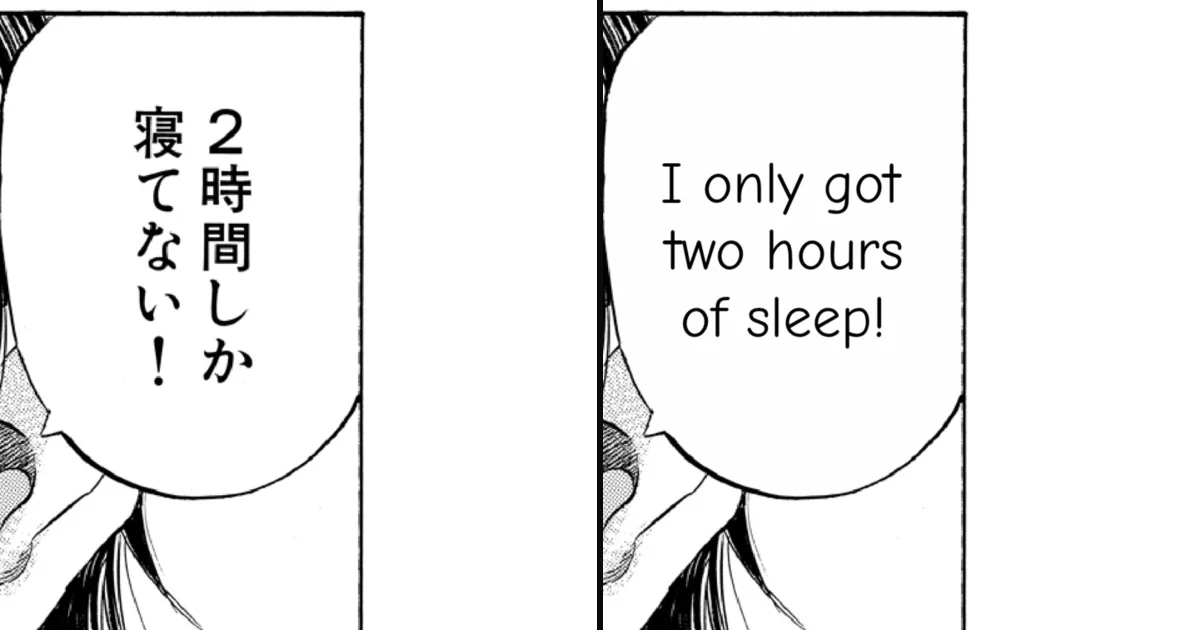
Reading manga in Japanese is one of the most enjoyable ways to learn the language: the pictures carry half the meaning, the sentences are short, and the dialogue is how people actually talk. It is also easy to give up on page three. This guide is about how to read manga in Japanese without giving up: what to read first, how to read a page, which tools help, and how to check that you understood it.
If you just want to know what a raw page says, translate it in your browser and read the two side by side. The rest of this guide is for reading it yourself.
What you need before you start
You do not need to be fluent, but some things make the first volume much easier:
- Kana, both hiragana and katakana, read without thinking. Sound effects and many names are in katakana.
- A few hundred common words and the basic sentence patterns: particles, verb endings, the polite and plain forms.
- Patience with kanji. You will meet kanji you do not know on every page. That is normal; the routine below is built around it.
Choose your first manga
The right first manga matters more than anything else.
- Furigana. Manga for younger readers print the reading of each kanji beside it in small kana (furigana). That turns an unknown kanji into a word you can look up. Yotsuba&! and Doraemon are classic picks for this reason.
- Everyday settings. School, family, food, work: everyday stories use everyday words, and they come back on every page. Fantasy, history and medical drama bring their own vocabulary.
- A series you already know. If you have read it in translation or watched the anime, you know who is who and what happens next, so your attention goes to the language.
- Short chapters. Finishing a chapter in a sitting is what keeps you reading.
How to read a page
Do not translate every word. Read the way you would read in your own language, and slow down only where it matters.
- Look at the page first. The panels, the faces and the sound effects tell you what is going on before you read a word.
- Read each bubble once, all the way through. Guess what you can from the words you know and the picture.
- Look up only what stops you. A word that blocks the meaning of the bubble is worth looking up; a word you can guess is not.
- Re-read the page. The second read, with the words you looked up, is where it clicks.
Manga Japanese is spoken Japanese: contractions, dropped particles, sentence-ending particles like よ and ね, and speech styles that tell you who is talking. Bubbles in vertical text read top to bottom, columns right to left; the page and the panels read right to left too.
Tools that help
- A dictionary you can search by reading and by kanji. For a kanji without furigana, search it by its parts or draw it.
- A pop-up dictionary for text you can select, for the parts of your study that are on a screen.
- A vocabulary deck. Put the words you looked up into a spaced-repetition deck (Anki is the best known), with the sentence from the bubble. They come back just before you would forget them, and the next volume gets easier.
Check yourself with a translation of the same page
Looking things up tells you what words mean; it does not tell you whether you understood the sentence. For that, compare your reading with a translation of the same page.
This is where a manga translator helps a learner. Drop a raw volume you own into Translate in your browser on serifu.net and each page comes back translated and lettered in its bubbles. In the page view, Original / Translated flips between the Japanese page and the translated one, and the list of lines beside it shows each bubble's Japanese next to its translation.
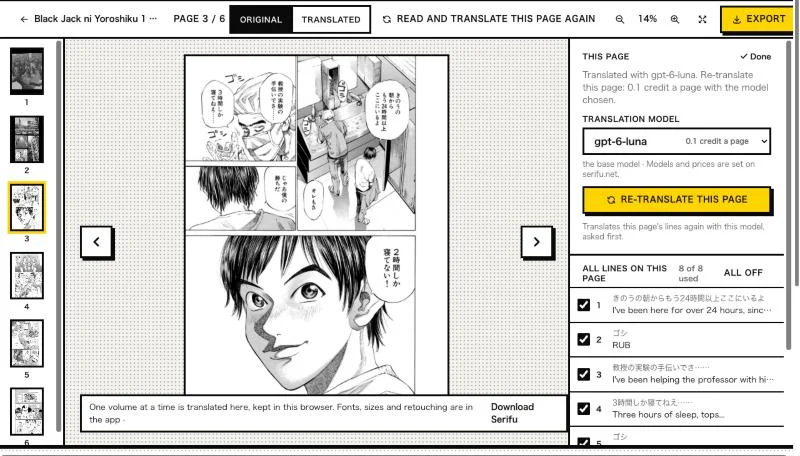
A good way to use it:
- Read the page in Original on your own, as above.
- Write down, or just say, what each bubble means.
- Flip to Translated, or read the line list, and compare.
- Where yours differs, go back to the Japanese and find out why: a word you did not know, a grammar point, or a joke.
A machine translation is a check, not an answer key. It reads the whole page and the two pages before it, so it usually knows who is speaking, but it can still miss a pun or flatten a speech style. When it and you disagree, the Japanese decides.
A routine that sticks
- A page or two a day beats a chapter a week. Little and often is how the vocabulary sticks.
- Re-read. The second time through a chapter you will read it at half the effort, and that ease is what makes reading feel like reading instead of decoding.
- Move up slowly. When a series feels easy, pick one with fewer furigana or a more demanding setting.
FAQ
What level do I need to start reading manga in Japanese?
Kana and a few hundred words are enough to start with a manga printed with furigana. Without furigana, you will want a few hundred kanji, or the patience to look them up.
Is reading manga a good way to learn Japanese?
It is a good way to learn how Japanese is spoken and to build reading stamina. It does not replace a course or a grammar book: use it alongside one.
Where do I get manga in Japanese?
Buy it: Japanese e-book stores sell digital volumes, and many bookshops import printed ones. Read and translate only the books you own.
Can I translate a raw manga to check my reading?
Yes. Serifu translates a volume you own, page by page, in the browser: 1 credit a page, with 5 free pages when you sign up. See Translate in your browser.