Japanese Honorifics in Manga: -san, -kun, -chan, Senpai
What Japanese honorifics mean in manga, from -san and -chan to senpai and sensei, how translations handle them, and how to keep them the same across a volume.
Serifu · · 6 min read
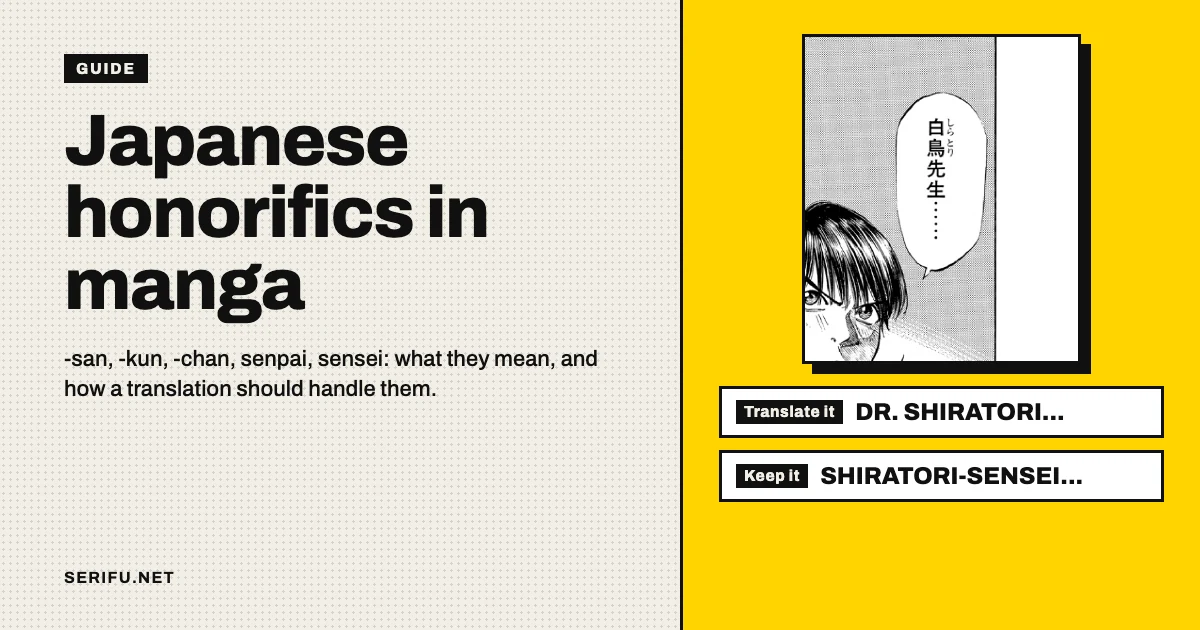
Japanese honorifics are the small words added to a name that say how the speaker stands toward the person: -san for most people, -kun for a boy or a junior, -chan for someone small or dear, -sama for someone far above, and senpai and sensei for a senior and a teacher. In manga they carry who is close to whom, who is older, and who is being rude. A translation has to decide, for every line, whether to keep them, replace them with an English word, or leave them out.
This guide lists the honorifics you meet in manga and what each one means, shows what happens to them in a translation (with a count from one real volume), and how to keep them the same from the first page to the last.
Japanese honorifics in manga: the list
| Honorific | Written | Used for | Closest in English |
|---|---|---|---|
| -san | さん | almost anyone: adults, strangers, colleagues; also shops and jobs (お医者さん, the doctor) | Mr., Ms., or nothing |
| -sama | 様 | customers, gods, nobles, someone admired; on yourself it is arrogance (俺様) | Lord, Lady, Master |
| -kun | 君, くん | boys and young men, juniors, a subordinate addressed by a boss | nothing; a first name |
| -chan | ちゃん | children, girls, close friends, pets: cute and familiar | a nickname, -ie |
| -tan | たん | a lisped -chan: babyish, or a fan's word for a character | (no equivalent) |
| senpai | 先輩 | someone above you at school, a club or work; used alone, as a name | (no equivalent) |
| kōhai | 後輩 | someone below you; rarely said to their face | junior |
| sensei | 先生 | teachers, doctors, lawyers, politicians, manga artists; used alone | Doctor, Professor, Teacher |
| -dono | 殿 | historical: samurai, officials, formal letters | Lord, Sir |
| -shi | 氏 | formal writing, the news | Mr., Ms. |
| -ue | 上 | historical, for parents and older siblings (父上, 兄上) | honoured father, brother |
| (none) | 呼び捨て | close friends, family, or an insult: dropping the honorific is a choice | (the contrast is lost) |
Family words work the same way and are often said to strangers: onii-chan (big brother), onee-san (young woman), ojii-san (old man). In manga they often mean "you, the young man" more than a real brother.
What -san, -kun, -chan, -sama, senpai and sensei mean
-san
The neutral one, and the one you will see most. It goes on family names (Kaneko-san), on first names between adults, and on words for jobs and people: 患者さん is "the patient", おばあさん "the old lady". So not every さん in a bubble is a name with a title on it.
-kun
For boys, younger men, and people below you: a teacher calls a student -kun, a boss calls a junior employee -kun, men or women alike. Between two boys it is friendly but not close.
-chan
Warm and small: for children, for girls by their friends, for a grandmother by her family, for a pet. On an adult man it is teasing. A rival who switches from -san to -chan is saying something.
-sama
Respect from far below. Shop staff call customers お客様; a maid says "o-jō-sama"; a fan says it of an idol. A character who calls himself ore-sama is telling you he thinks he is great.
Senpai
Anyone ahead of you in the same school, club or workplace, by a year or by twenty. It is said alone, as a name: "Senpai!" English has no word for it, which is why so many translations keep it.
Sensei
Not only teachers: doctors, lawyers, politicians and the manga artist themselves are sensei. Like senpai it is used alone, in place of the name. In a medical or school manga it is everywhere.
What happens to honorifics in a translation
There are four ways to handle them, and published translations use all four:
- Keep them: "Kaneko-san", "Senpai!". Close to the original; readers who know them hear the relationships. New readers need a note.
- Translate them: "Mr. Kaneko", "Dr. Saito". Reads naturally in English, but -kun and -chan have no English word and disappear.
- Leave them out: "Kaneko". The cleanest English, and the relationships move into the wording, if they move at all.
- Mix: keep senpai and sensei, translate -sama, drop -san. A rule many fan translations follow.
There is no right answer. The wrong answer is to change your mind halfway through a volume.
One volume, four ways to say sensei
We counted it on a real volume. Give My Regards to Black Jack vol. 1, a medical manga by Shuho Sato, is 209 pages and 1,078 lines of dialogue. 先生 appears in 51 of them, on 41 pages. Translated by a model with no rule for honorifics, those 51 came out as:
| Translated as | Lines |
|---|---|
| "Dr. ..." or "Doctor" | 37 |
| "Sensei" | 6 |
| "Doc" | 4 |
| "you", or "teacher" | 4 |
Each one reads fine on its own page. Together they make one character's title change from scene to scene. -san went the same way: さん is in 47 lines; "-san" survived in 6 and "Mr." or "Ms." in 5, while the rest became plain "Kaneko" or nothing (many of the 47 are not names at all: the old lady, the patient).
How to keep honorifics the same across a volume
What fixes it is a rule, written down once and given to whoever translates every page, a person or a model:
- Pick one of the four ways for the series and say it in a line: "keep -san, -kun, -chan, senpai and sensei; translate -sama as Lady."
- Write down what each character calls each other: the student calls the doctor "Saito-sensei", the nurse calls him "Dr. Saito", his rival calls him "Saito". The honorific is part of how they speak.
- Keep names in one spelling, with or without the suffix, in a glossary.
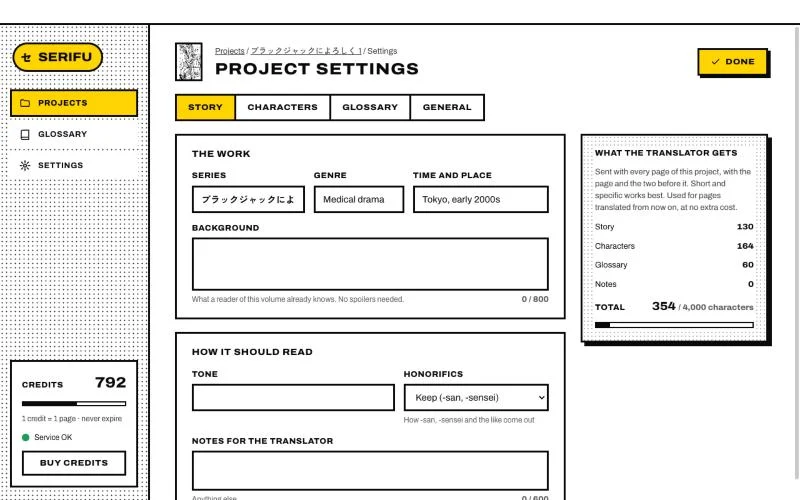
In Serifu, this is what a project's Story is for. Project settings › Story › Honorifics has the four choices (keep them, translate them, leave them out, or leave it to the translator), and each character has what others call them. Both go with every page of the volume the app translates. On our reference pages, setting it to keep them doubled the honorifics that stayed in the English (8 against 4). See Story and characters.
FAQ
What does -san mean in Japanese?
It is the general polite honorific, like Mr. or Ms. but used for almost anyone: adults, strangers, colleagues, and people known by their job.
What is the difference between -kun and -chan?
-kun is for boys, younger men and juniors; -chan is warmer and smaller, for children, girls, close friends and pets. Calling a grown man -chan is teasing.
What does senpai mean?
Someone ahead of you at the same school, club or workplace. It is used alone, in place of a name.
Should honorifics be kept in a manga translation?
It is a choice for the whole series, not for each line. Keep them for readers who know them and for stories built on rank (school, the workplace, history); translate or drop them for a reader new to manga. Mixing is fine if the rule is the same on every page.
Why do some translations say "Doctor" and others "Sensei"?
Sensei covers teachers, doctors, lawyers and artists, so an English translation has to pick one, or keep the Japanese word. Without a rule, one translation can do both in the same book.